Aug 15 2010

Electricity!

Rebekah

Hi all! So our latest house building adventure has been the electricity in the upstairs. Here is where we started from: the house has electricity on the bottom floor, with 1 panel, Kellan has added some lights and receptacles (the plugs) to the bathroom, however… there was absolutely no electrical connections for the upstairs. Really, the upstairs only had the studs up for three bedrooms, a small hallway, and two closets. Before we even began the electrical work we built the third closet, a window seat for the master that is going to be absolutely spectacular, and the headboard for the master bedroom. In this picture, the bay was already built, but we added the section of that crosses straight across for the window seat. This is the future headboard! It is slightly wider than the width of the bed. It is wired for sconces on both sides on the headboards. We’re gonna do some sort of stain glass arches, but we’re trying to make those as well. We had to do all the framing first since we have to run all the wires through those boards, it would be hard to return to it later and add it all in.
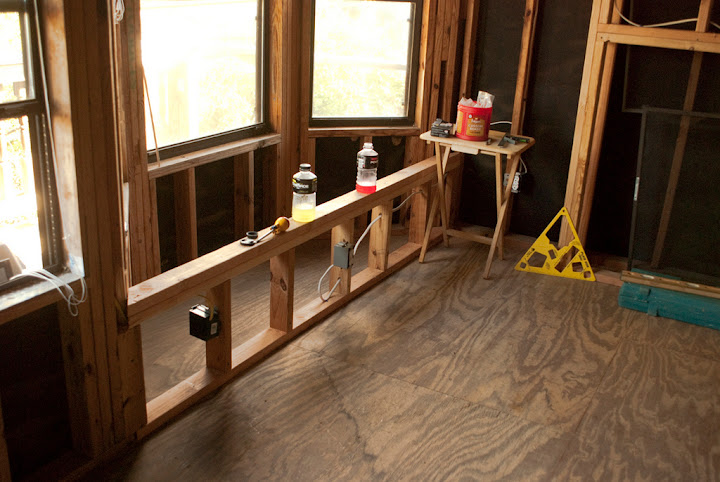
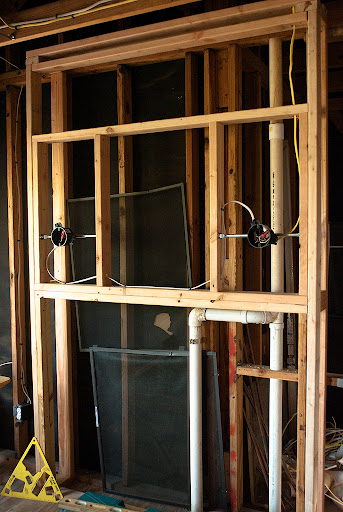
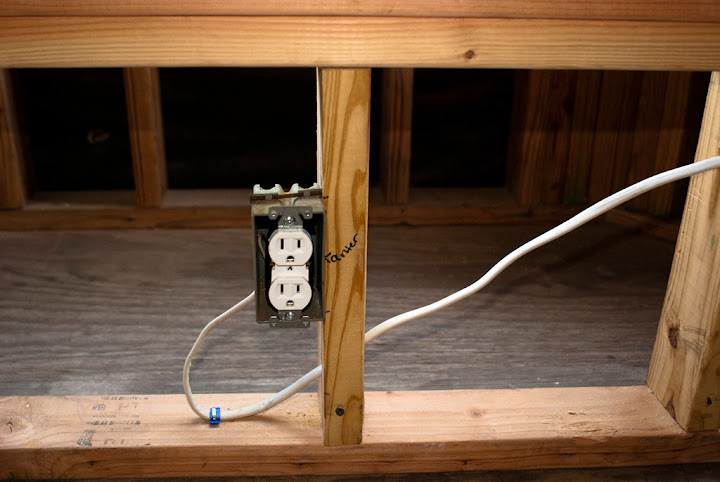
Anyway! We got onto the electrical work as soon as we finished those small (haha) projects. Well, I was watching Kellan have a go at the lights in the hallway and I said to myself, “I’m bored! I’m gonna learn how to wire the plugs!” So, I grabbed the wiring book Kellan had, read up on it, and in the next 30 minutes I had all 17 receptacles ready to go! Not quite… but, it really was not hard. Kellan helped me with the first couple, but I had a blast wiring all of them! Here is my first plug!! The hardest part was actually getting the Romex (wire) to the receptacles, its really tightly wound in spirals, so its hard to get it through the all the studs. After that, all that wiring plugs involves is stripping the romex, figuring out which wire in the hot, the ground, and the neutral, and then hooking those wires up to the correct screw on the back of the plug. Thats the basics anyway!
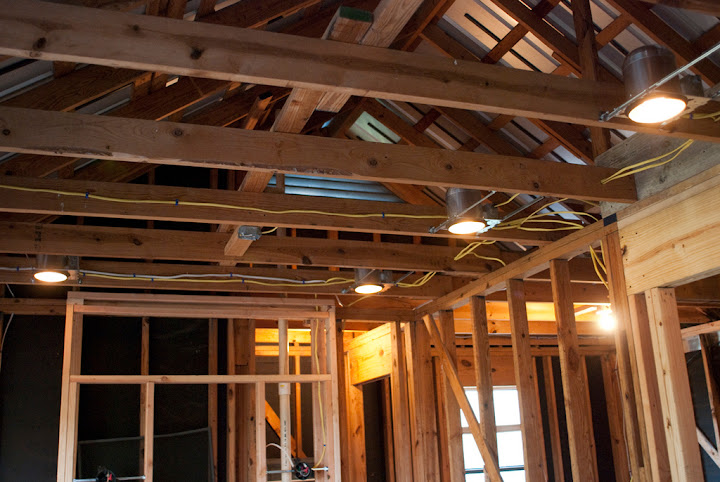
As much as I slaved away, Kellan REALLY got after it. To make it all work, he had to put a subpanel in the hallway t0 meet code for the electricity. The crazy subpanel: We have 5 breakers for the upstairs. I don’t remember exactly what we combined with which breaker, but Kellan kept all that straight as well as all the stuff he wired! All 3 closets have just a regular light bulb and the 2 spares rooms have are wired for a fan/light combination, which actually require wire slightly different than everything else we used. Other than that, all the other lights are can lights, or recessed lights. Kellan wired 5 can lights for the master ceiling, 2 can lights for the window seat, and 2 can lights for hallway. The can lights: The fan and the lights in the master are on dimmers and the 2 lights in the hallway are on a three-way switch. Pretty complicated stuff considering me! The three-way switch in the hallway looked the most complicated, but Kell got it!
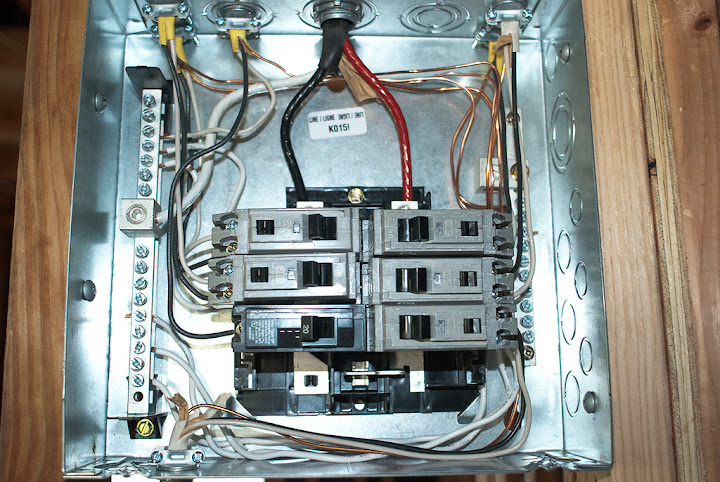
Well, we got to the point where all the wires were joined to the breaker and the subpanel was joined to the main panel. SO! Kellan ran upstairs (with the fire extinguisher!) while I stayed downstairs to flip the breaker for the subpanel. I gave him a good countdown, and flipped the breaker, and WOOHOO! That fire extinguisher wasn’t necessary, thank goodness! I joined Kellan upstairs and got to see lots of pretty lights on! The ONLY problem we had was the three-way switch, which is a really complicated one so we were slightly worried. Thankfully, it only required pulling out a switch and tightening some screws. WOOHOO for real. It was really exciting, and definitely a big accomplishment.

Aug 4 2010

An Exciting Discovery…

kvincent

So I was sitting at my desk when AJ comes into the office obviously excited about something. While mowing the grass on the property he noticed something that none of us had previously; the mustang grapes that grow throughout the office grounds were fruiting. Upon a further look of the fence line and nearby trees we were astounded by the amounts of fruit that the vines were bearing. AJ and I immediately started coming up with a plan on how to harvest and process the daunting amount of grapes hanging out of the trees. The summer heat would not allow the already ripened grapes to remain much longer.

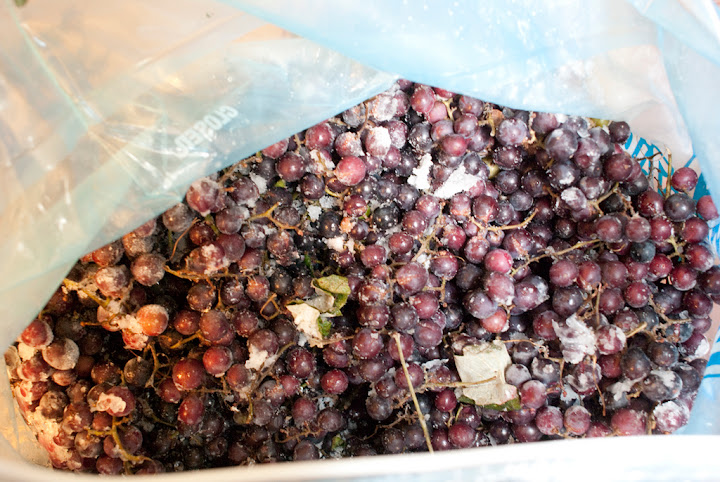
Our plan was to pick as many as we could reasonably from the ground, then in the following day or two, use ladders to pick the ones in the trees. It took three different ‘attacks’ but the result was worth it! All in all, I believe we picked somewhere in the neighborhood of 12-15 gallons of mustang grapes! To us this was a pretty incredible sight!

The first batch of picked grapes that we temporarily froze

Once off the vines, it was time to figure out what to do with all of the fruit! Mustang grapes are notoriously acidic and capable of burning skin (as Rebekah’s feet later found out). However, they make terrific jellies, jams and wine so we began the process of juicing and macerating our harvest. We decided to make mustang grape jelly, and some mustang wine.

Wine (all types, grape fruit etc.) was originally used as a way to allow juice to store for long periods of time without it spoiling and becoming dangerous to consume. Especially before the ability to sterilize and pasteurize, the natural yeasts on the skins of the fruits would start this process and if exposure to oxygen was minimized, a palatable end product would result. In biblical times they would allow the mix of crushed grapes and juice (called must) to sit in a large vat until eventually transferred to goat skins and sealed containers to minimize spoilage. Our goal with this wine was to bring up the alcohol content just to the point that we can bottle store and keep the wine for an extended period of time without it going bad or if we desire, we can convert it to red wine vinegar (essentially the careful spoiling of wine). Sauerkraut when made properly is actually a fermented product as well, and “keeps” for many of the same reasons that wine does.

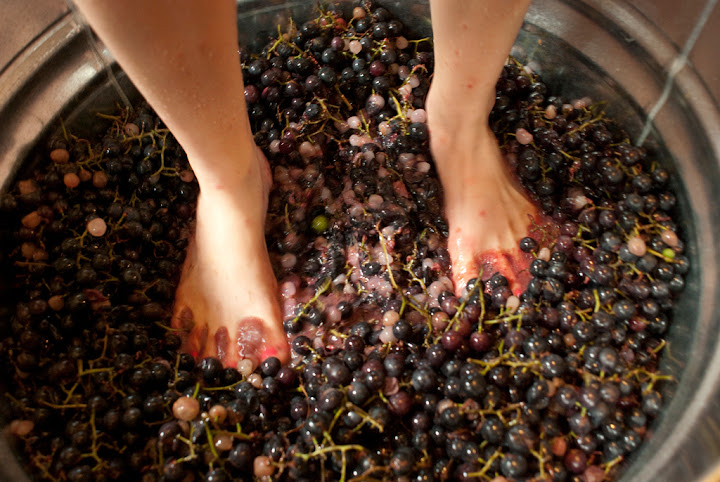
The first step in this process was to crush the grapes and create a must. We did a lot of brainstorming but our eventually solution was to use a large metal bucket and crush them in that. The lovely Rebekah volunteered to be the grape crusher and so began the grape stomping process. I think most people are familiar with the classic image of people stomping grapes in a large pail. Well, it was a lot like that, however we learned a couple of things…

  • Mustang grapes are VERY acidic and people should probably heed the warnings to wear rubber gloves.
  • Burning from acidic grape juice will make Rebekah’s feet look sunburned
  • Stomping previously frozen grapes will easily give you frost bite and you might as well give up
  • Potato mashers are a huge help :)

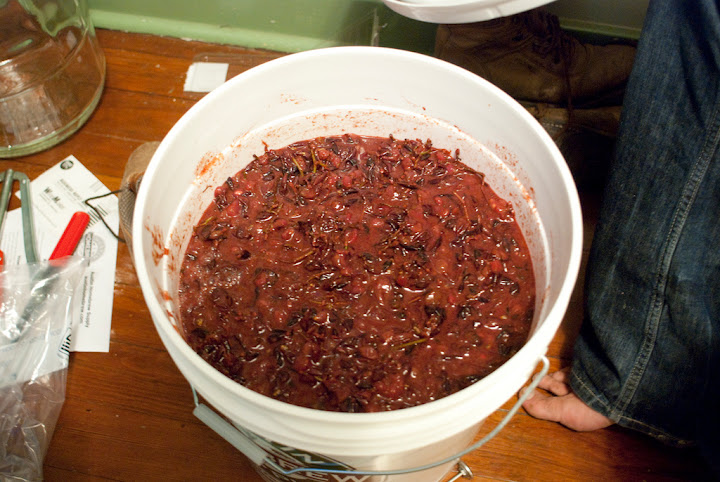
Rebekah stomping our grapes!

Once the grapes were turned into must, we put them all in the primary fermenting bucket. This is essentially a food grade plastic bucket with a sealed lid and an airlock. We added a little bit of sugar and yeast to help the process along due to the very low sugar content that mustangs have. Fermentation (pickles, sauerkraut, wine) is really interesting to me due to the mixed amount of sciences you use to create the end product. Its a dynamic mix of chemistry, physics and biology and definitely a challenge!

Must in the primary fermenter

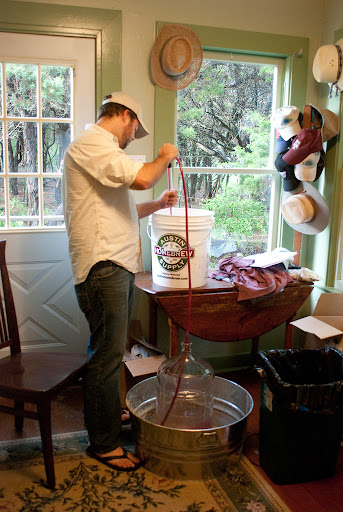
After five days we strained and siphoned the must into the secondary container. This is where malo lactic fermentation occurs, making the juice taste better. We also added a bit more sugar and water at this phase. Specific gravity readings are used to determine approximate alcohol content which is an interesting thing in itself.

Kellan siphoning juice from the primary to the carboy on the ground

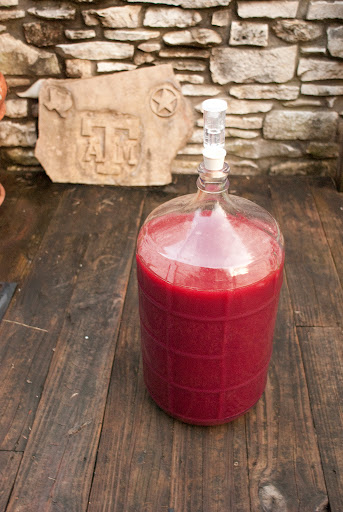
The end result of siphoning!

From this point on it is a waiting game. While I believe we’ve been doing things right, we wont know for another month or two. In that time we’ll probably re-rack the wine into a smaller container to allow it to age a bit longer and then eventually bottle everything! Ross (my Dad) and I have had numerous discussions on strategies over the course of the process. Given its our first attempt, who knows what will happen. In a week’s time it has already cleared considerably and gotten darker so fingers crossed! :)

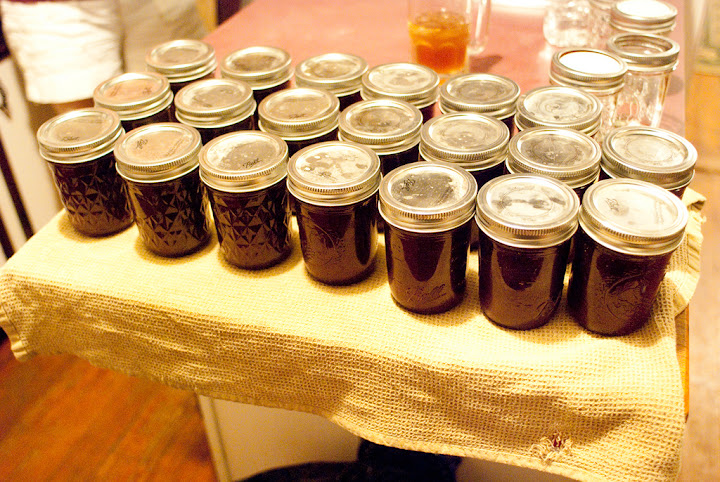
Meanwhile, Rebekah and I also decided to work on making some mustang jelly so we picked more grapes and mashed them with a potato masher then strained the mash through a cheese cloth to remove as much of the solids as possible. For jellies to keep, you have to pasteurize everything to prevent bacteria from forming. We added sugar to our raw juice and brought everything up to a quick boil. We then added fruit pectin and sterilized the jars and lids. It was a tedious process but the results were great! We ended up making 20 – 8oz jars of jelly with probably another 10 or so jars worth of juice left over. The jelly is slightly tart with a LOT of flavor. So much better than store bought grape jelly.

The results of our efforts!

Over all I think our foray into grape processing went very well and was a lot of fun. We will update on the progress with house construction very soon!

-k. vincent


Aug 3 2010

It is for the bees…

kvincent

I wanted to take the time to briefly tell of our progress with our 15 thousand or so ‘girls’ we have in the back yard! Yes, for those who are wondering, the majority of a bee colony is comprised of worker bees who are all female. Just a little tidbit of information for those taking notes! Our first foray into beekeeping has been an incredibly rewarding and challenging experience. It is a very dynamic mix of biology, chemistry, animal husbandry and stewardship of the tiny creatures.

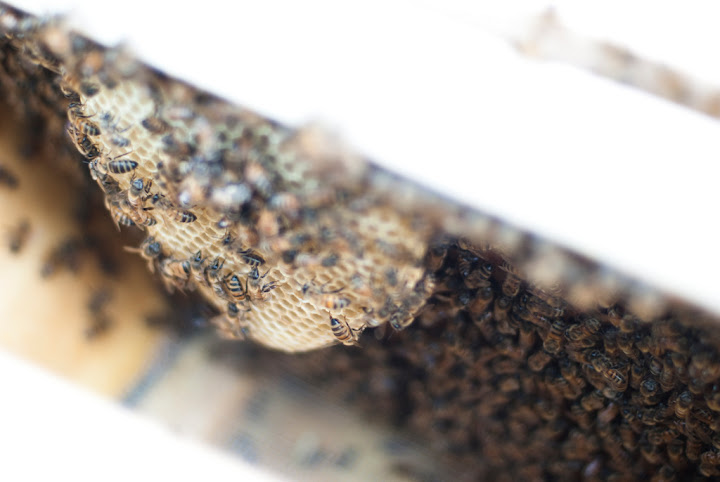
On April 12th I installed a 3-pound box (between 8-10k bees) into a top bar hive I built. A top bar hive is a bit different from the more common Langstroth hives people are more familiar with. Instead of having frames installed in the hive with a comb foundation already created, top bar hives require the bees to build and arrange their own comb by attaching it to the bottoms of the wood top bars. The comb is created by bees “festooning” or hanging from the bars in sheets grabbing on to one another and passing the wax that the bees create on their abdomen to the bees at the top who chew it up and place it. While the process seems rather complicated, its tremendous how quickly they can build, with entire combs being ‘pulled’ in a matter of days.

Since the installment of the package, we now have 12 fully pulled bars, with 2 more in progress. Early on there were some problems with establishment of a brood nest (where all the eggs are laid). While I’m not sure exactly the reasons behind why there was not a very strong build up at the beginning, there was definitely a decrease in population over the first month. Eventually the hive got up and running fully, and probably has between 15-20k bees.

As far as I can tell we have had 3 different queens in the hive. The original packaged queen got superseded within the first 6 weeks. The resulting queen was very quickly replaced, and now we are on our third. On a very exciting note, we have actually seen the queen within the hive this last week! She’s quite large so its a bit astonishing that we have not seen her till now.

Currently it is the hottest part of the summer in Texas and the amount of wildflowers and ornamental flowers blooming is in a dearth season. There will be another honey flow season once things cool down and our second growth season kicks in. I am hoping to really see a build up of comb, brood, and honey this next growth season to make sure they will last through the winter.

Anyway, I figured I would make a note of our first beekeeping season so far in order to not only hopefully entertain our readers, but to keep notes on what we are observing. Rebekah is becoming quite the beekeeper herself and has been able assist me a few times now. Eventually, I hope to have several hives out at the family farm! We also have a couple of clients that want one next spring as well. Could be fun :)

Here are a few photos from our last hive inspection…

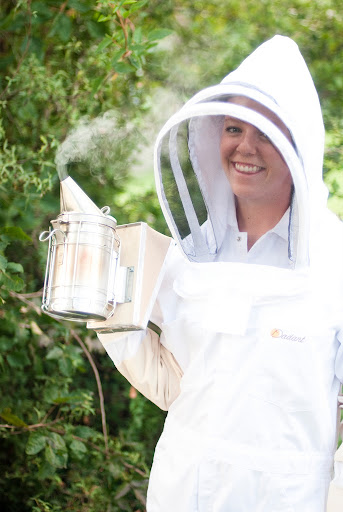
Rebekah with her smoker!

Lots of bees